
Description
Perhaps the most extraordinary and meaningful aspect of this opera is its deeply personal story: the libretto was written by Kao Kalia Yang, daughter of Bee, the central figure in The Song Poet. This is her family’s story, brought to life on the operatic stage through her own words and perspective. Originally commissioned for Project Opera, Minnesota Opera’s premier youth vocal training program, the work ultimately found its way to the company’s main stage, where it premiered in March 2023. The production was met with extraordinary enthusiasm, with the entire run selling out more than six months before opening night.
… the libretto and music are both written by women…, the music is unique for the genre, the staging includes stunning interpretive dance vignettes, and the writing never lets the heavy nature of the content get in the way of the beauty and whimsy of the storytelling. In short: it’s a breath of fresh air.
Buer Carlie, Lavender Magazine
The Song Poet Songbook will be available in 2027.
Synopsis and Scenes
Bee has run away once again into the beloved mountains that surround his village after the death of a friend by gunfire. War planes zoom overhead. He climbs the tallest tree he can find. He is looking for a father who has been long dead, wondering where his friend has gone. His mother and older brother look for him in the undergrowth, afraid he will get killed. On his tree limb, the boy holds tight as canopies of forest fall around him.
In the middle of a jungle, Bee passes by a young woman with beads in her hair named Chue. A love story begins. The figure of a young man and woman dance in a jungle ballroom. When the soldiers come, they flee in the same direction.
Chue is pregnant. The soldiers are coming. Bee and the rest of the men must leave the women and children. Underneath the overhang of a bamboo grove, the young couple parts. Bee tells Chue, “If I do not return, find a way to your mother, she will love you and our child.”
A reunion in the dark. Fire explodes into the night, as the group of refugees run for a river that will separate their past from their future forever—a land on the other side of the rushing water, a country on the other side of the green earth.
In Thailand, Bee befriends two dogs. He finds out refugees cannot take pets with them. Bee must say goodbye.
In America, Bee and Chue are impoverished refugees, living in the housing projects, raising two girls. They sing of fallen dreams while their girls learn the songs of America. Bee finds work in a factory where his supervisor pushes the men to work “harder, faster, smarter!”—as the machines cry with them.
Bee’s daughters look for pathways to the future. One decides to become a writer, to share the story of her father with a world he has grown afraid of believing in. They discover that “sisters are life partners, too.”
In the epilogue, the family returns to the high mountains of Laos. The old tree has long disappeared. In its place, a new one grows. The mountains stand—jagged remains holding true all that had been and all that can still be. Bee realizes, his wife beside him, his girls in front of him, that time holds the treasures he was afraid to believe in, that indeed the Hmong brothers and sisters have found a way forward.
Scenes:
Scene 1: The Mountains Will Speak—for Laos was the most heavily bombed nation in the world only the world didn’t know it. More bombs were dropped on Laos per capita than any other.
Scene 2: Love in Wartime
Somewhere in the jungles of Laos, March of 1978
Scene 3: Leaving Love Behind
Deep in a bamboo forest in the jungles of Laos, December 1978
A Moment:
The crossing of the Mekong River, Thailand and Laos, April of 1979
Scene 4: Refugees Can’t Take Pets
Ban Vinai Refugee Camp, Thailand, January of 1987
A moment:
The leaving at Suvarnabhumi International Airport, Bangkok, Thailand, July of 1987
Scene 5: The Cold is Coming.
St. Paul, Minnesota, U.S.A., October of 1987
Scene 6: The Machines at the Factory|
Brooklyn Center, Minnesota, U.S.A., August of 2012
Scene 7: Words Wanted, Ideas on the Line
A sunny office in St. Paul, Minnesota, July 2005
A moment: We are in a big ballroom that is to recall the original jungle ballroom where Bee and Chue meet and fall in love—except it is no longer a jungle, instead the room is set with banquet tables and fine cutlery, fancy glassware and flowery centerpieces.
Scene 8: Return to the Mountains
Xieng Khouang, Laos, December of 2018
Setting and Cast of Characters
Setting
- Xieng Khouang Province, Laos, May of 1971
- Jungles of Laos, January 1978
- Bamboo forest in jungles of Laos, December 1978
- Mekong River, April of 1979
- Ban Vinai Refugee Camp, Thailand, January of 1987
- Suvarnabhumi Airport, Thailand, July of 1987
- St. Paul, Minnesota, U.S.A., October of 1987
- Brooklyn Center, Minnesota, U.S.A., August of 2012
- Xieng Khouang Province, Laos, December of 2018
Cast
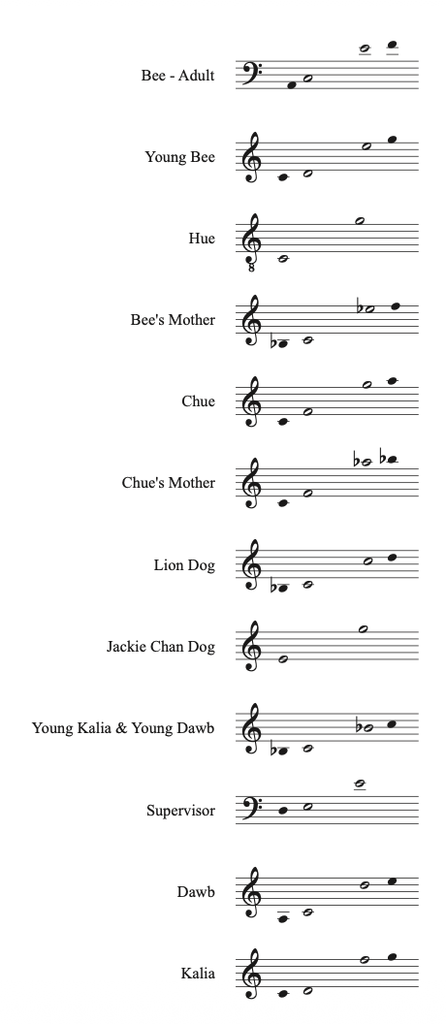
- Young Bee Yang, The Song Poet (Hmong)
- Bee Yang, The Song Poet (Hmong)
- Hue Yang, Bee’s older brother (Hmong)
- Youa Lee, Bee’s mother (Hmong)
- Joua Thao, Chue’s mother (Hmong)
- Chue Moua, His Wife (Hmong)
- Young Dawb Yang, First Daughter (Hmong)
- Dawb Yang, First Daughter (Hmong)
- Young Kalia Yang, Second Daughter (Hmong)
- Kalia Yang, Second Daughter (Hmong)
- Lion Dog
- Jackie Chan Dog
- Supervisor
- 3 Factory Workers (Hmong)
- Chorus roles:
- The Mountains of Xieng Khouang (SATB, 9 soloists, 2 duets, 1 small group)
- The Wind, 2 groups (SSA + 2 soloists, unison sung in Hmong)
- The Hungry Dogs of Ban Vinai (unison)
- The Machines in the factory in Minnesota (4 groups, unison, SSA, TTB, unison)
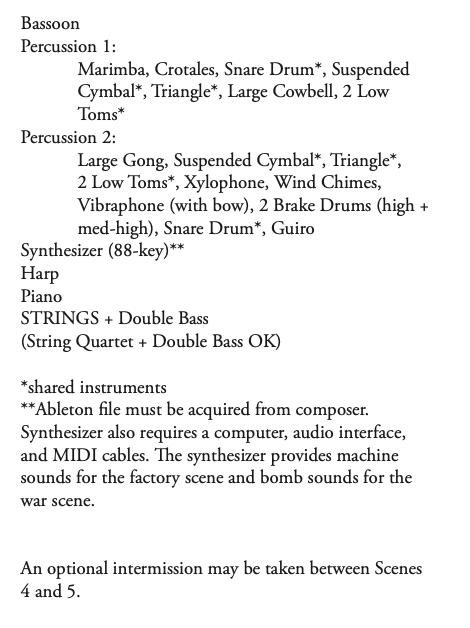
Vocal Ranges and Instrumentation
Announcement and Process
Premiere
The Song Poet premiered with Minnesota Opera on March 9, 2023.
Press and Reviews
Jocelyn and Kalia
